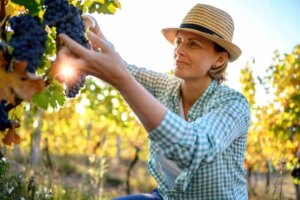
Born in Seville and Ronda by adoption, Simbad Romero became interested in the world of winemaking while still studying Chemistry at university. After a long journey that took him through several countries in both the northern and southern hemispheres, he returned to Spain and settled in Ronda ten years ago. From there he has been involved in several projects, including Badman Wines, located on the road to Fuente de la Higuera. Now the time has come to create his own brand and put his name, Simbad Romero, on a bottle label. He does so with four extreme natural wines: sparkling, white, red and orange wine, “which represent the land they come from in the simplest possible way”.
How was Simbad Romero born as a brand?
-It was during the last harvest, in 2024, when I decided to take this small step. I wanted to release a line of natural wines, perhaps a second Badman brand, but in the end I decided to do it on my own and put my name on it. Professionally, in the world of wine, there comes a moment when you put your name on a label because it is something very much yours, something that represents what you think about winemaking. I said, why not? The time has come, and I went for it.
Also because there is a lot of demand. I make natural wines in Mijas and in Galicia, in the Ribeira Sacra, and almost my entire career has been closely connected to biodynamic and natural wines. Many people asked me why I was not doing it in Ronda, where there was still no line of natural wines as extreme as the one I have made. They are people from restaurants or from the world of winemaking who know the wines I have made, that I make and sell in Spain and around the world, and together they encouraged me to make a few bottles in my own way. In the end, that is all they are: my concerns. They are the wines I believe in most, trust most and enjoy most, and I also wanted to do something like this in Ronda, where I live.
In the end I went for it. I have made very few bottles, 880 in total, across four different types of wine, and for the moment I have already introduced them in a few places. There are wines, for example “Leon”, which I dedicate to my son, of which I made 56 bottles and have 30 left; people who have tried it have told me they want a thousand bottles.
Life has taken you around the world, from the northern hemisphere to the southern hemisphere.
-I studied Chemistry in Seville, and while finishing my degree in Austria on Erasmus, I was offered a research project in several wineries in the area where I lived. I found the chemistry of wine fascinating. Although I had already taken some related subjects at university, in practice I really liked it. So I went to Cordoba to study Enology. I have both degrees. From there I began travelling around the world. In the first year of Enology I went to Italy for four months. Once I finished, I returned to Italy and began my route: Argentina, Chile, California, two years in New Zealand, then Australia, France, South Africa. In Spain I spent a year in Catalonia, but I thought that if I was coming back to Spain I would return to my own land, so I came to Ronda and stayed. I have been here ten years.
How much of all that is there in Simbad Romero wine?
-All of that has shaped the person I am. I have been lucky enough to work with many types of people: male and female winemakers, vineyard workers, cold climates, warm climates, ten countries. Everyone does things differently, and that has given me a very broad vision. In the end, I choose from all of it.
Since my time in New Zealand I have focused on natural wines and biodynamics. That is when I said, this is what I want, this is what I like. And although I have worked for other wineries making conventional wine, I have always marked out my own path. With the knowledge I have acquired, I have been able to arrive at the wine designs I created with Simbad Romero. Each one reflects my concerns and my way of approaching things.
The white wine is not a common white wine; it is something different or unusual, which is what I want to offer by putting my name on it. It is a responsibility to put your name on a label.
I have used four techniques for four different wines. From the whole range of techniques that exists in the world, I selected four that I believe work well for what I want to do. That is how I designed the products, and now they are for sale. I say extreme natural because, for me, natural means first that it comes from sustainable organic farming, and then that in the winery no sulphites are added, and there are no stabilisations, acid corrections or filtrations. It is grape and nothing else. I have taken the grape and guided it to a certain point. Everything is very natural.
And what does the consumer find when tasting Simbad Romero wines?
-I think that when you come across a wine like this, at first it surprises you because you are not used to those palates. It also surprises you because you find flavours or aromas that conventional wines do not extract because of how they are made.
The other day I presented the wines at a restaurant in Cadiz for about 30 people, and they left telling me that I had changed their idea of natural wine. There are well-made natural wines: honest, clean wines. I loved hearing that from consumers who did not know me. They are wines with a maximum of 10 to 12 degrees of alcohol, very fresh, lighter, and they surprised people.
How are they distributed?
-For now I send the wine directly to restaurants in Cadiz, Seville, Madrid, Barcelona and Ronda, and the idea is to start exporting with the wines I release next year. As long as I am enjoying it and it gives me a minimum profit, we will keep taking small steps until we find the right production scale.
Do you work with vineyards in Ronda?
-The vineyards are in Ronda, one from Badman and others we have been working with for some time, all managed organically. I try to find vineyards that work that way so I can make different things.
What are the characteristics of the four wines you produce?
-“La Utopia” is a sparkling wine made by the ancestral method, much older than the traditional method. It is very creamy, very crisp, very vertical and very aromatic, because Sauvignon blanc is a highly aromatic variety and the aromas have integrated very well. For six months of ageing, it is spectacular.
The white wine is made from Moscatel de Alejandria (“El Marino”). Its profile is very saline, very fresh, very aromatic and very light, with 11 degrees of alcohol. It is very saline because it comes from albariza soil in Manilva, and the vineyard is 200 metres from the sea.
The red (“Las mil y una noches”) is made like the classic carbonic maceration reds, fermented cold, a wine to drink chilled, with 12 degrees of alcohol. It is very elegant, very aromatic, very generous, with maceration aromas of candy, strawberry and cream. Very light.
“Leon” is an orange wine, made with Sauvignon blanc macerated with the skins for five days. It is a highly complex wine; although citrus notes predominate, it is also floral on the nose. All the aromas are in the skins, and that gives it great complexity. It is very soft on the palate, very direct and reaches you immediately. It is surprising.